
What is Inferencing?
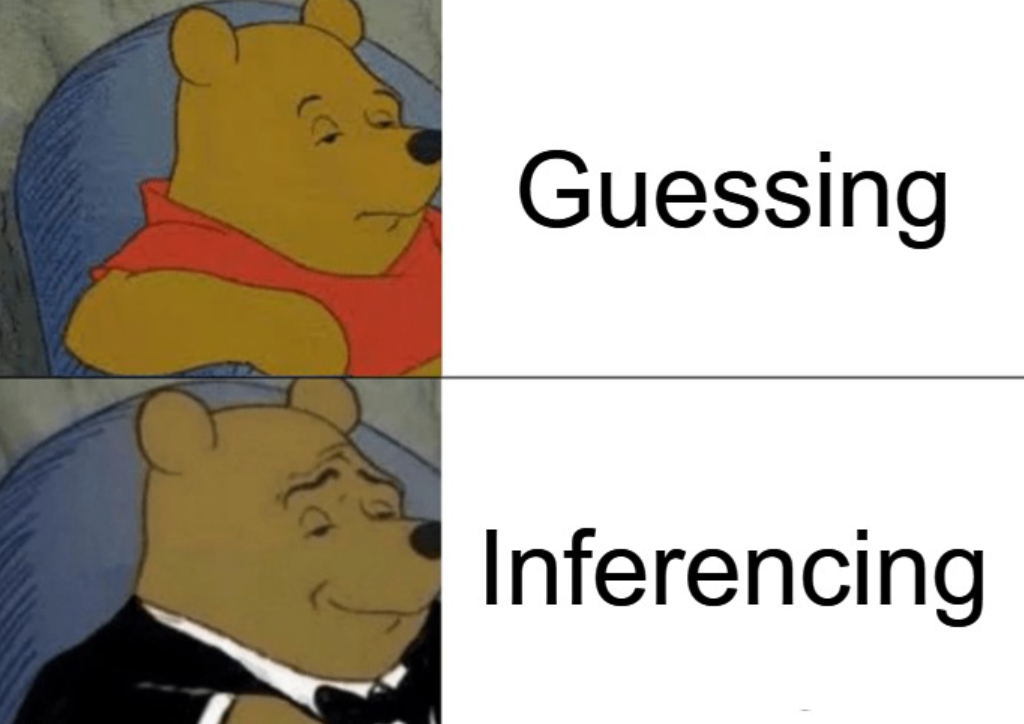
If someone can answer “who”, “what”, and “where” questions but continues to struggle with understanding what they read or hear, there is a good chance the difficulty lies in inferencing.
Inferencing is often described as “reading between the lines”. It forms a core component of language, thinking, and social understanding and we use it many times a day.
What is inferencing?
Inferencing is the ability to work out the meaning of something that isn’t directly told or revealed to us.
It involves combining:
What was said (or read)
Prior knowledge
Context and clues
—> in order to arrive at a deeper understanding.
For example:
“Tom put on his coat and grabbed an umbrella.”
Someone with strong inferencing skills might say: “It’s probably raining outside”. That information wasn’t stated in the example, but it was implied.
Research shows us that inferencing is critical for reading comprehension and academic success. Without it, children as well as those who struggle with inferencing tend to take language literally and miss the bigger picture.
Why do some people struggle with inferencing?
The reason is because inferencing isn’t a single skill, rather, it relies on multiple systems working together.
Someone may struggle due to difficulties with:
Vocabulary knowledge
Background or world knowledge
Working memory
Attention
Flexible thinking
When there are deficits in these areas, people may:
Miss the implied or underlying meaning
Misinterpret conversations with friends
Struggle with humour, sarcasm, or figurative language
Have difficulty answering “why” and “how” questions
This is why inferencing can be described as a hidden language skill because it’s not obvious, but it plays such a major role in communication.
How do we (and you!) teach inferencing?
The good news is that inferencing can be taught and there are some strong evidence-based strategies to support it.
Here are some effective approaches:
1. Shared (dialogic) reading
This involves actively engaging the person while reading a story.
Instead of simply reading to the person, you:
Pause
Ask questions
Discuss meaning
This supports people to build connections and develop a deeper comprehension of what they read.
2. Talk out loud your thought process
Here, the adult discusses their thinking process:
“Hmm… she’s crying… I think she might be sad because her toy broke.”
This reveals the inferencing process to the person and makes it explicit.
3. Teaching “why” questions
Encouraging the person to ask and answer:
Why did that happen?
Why did they do that?
This strengthens reasoning skills which is one of the foundations of inferencing.
4. Explicit teaching of clues + background knowledge
Children often need to be taught that good readers use clues and what they already know. Explicit teaching involves:
Highlighting key words
Making links to real life experiences or real world knowledge
Building missing knowledge
What does inferencing look like in a speech pathology session?
In a session, we often target inferencing through:
Picture scenes (e.g., what is happening? how do you know?)
Short stories with guided questions
Social scenarios (e.g., why do you think he said that?)
Prediction tasks (e.g., what might happen next?)
The bottom line
Inferencing is one of the most important language skills we can grow and support in those who have difficulty with it. While it doesn’t always develop automatically, it can be taught effectively with the right approach.
If a person is struggling to understand language beyond the surface level, targeting inferencing can make a significant difference in their academic participation, but also in everyday life.